In short
- An account-takeover call rarely sounds like fraud. It sounds like a stressed customer who needs one small change, right now: a new email, a new phone number, a new payee.
- InsightCallIQ scores every call for fraud risk from 0 to 100. Every point carries its reason: what was said and at which turn, which device, which number, how the voice compared with the account holder's voiceprint.
- The bands are plain: low below 40, medium from 40, high from 70. A high-risk call becomes an alert, the fraud analyst agent prepares a review, and a person decides whether it is fraud.
- A call can pass every compliance check and still be a takeover. That is why fraud is scored separately from QA and compliance, on the same transcript.
The call that follows the script
The most instructive call in the Harbourline Financial demo is not the one where an agent made a mistake. It is the one where the agent did almost everything right.
The caller asks to change the email on the account. They are at the airport, locked out, and it is urgent. The agent greets them, says the call is recorded, and asks for a date of birth before touching the account. The caller gives a date, asks what address is on file "so I know which account it is", supplies a new email and then asks to add a new payee "as quickly as possible". The agent updates the email.
Scored for quality, the call does well: the greeting, the recording disclosure and the identity question are all there, in the right order. Checked for compliance, it passes. Scored for fraud, it is high risk. Those three results are not in conflict. They answer different questions, and an account-takeover call is exactly the call where the difference matters.
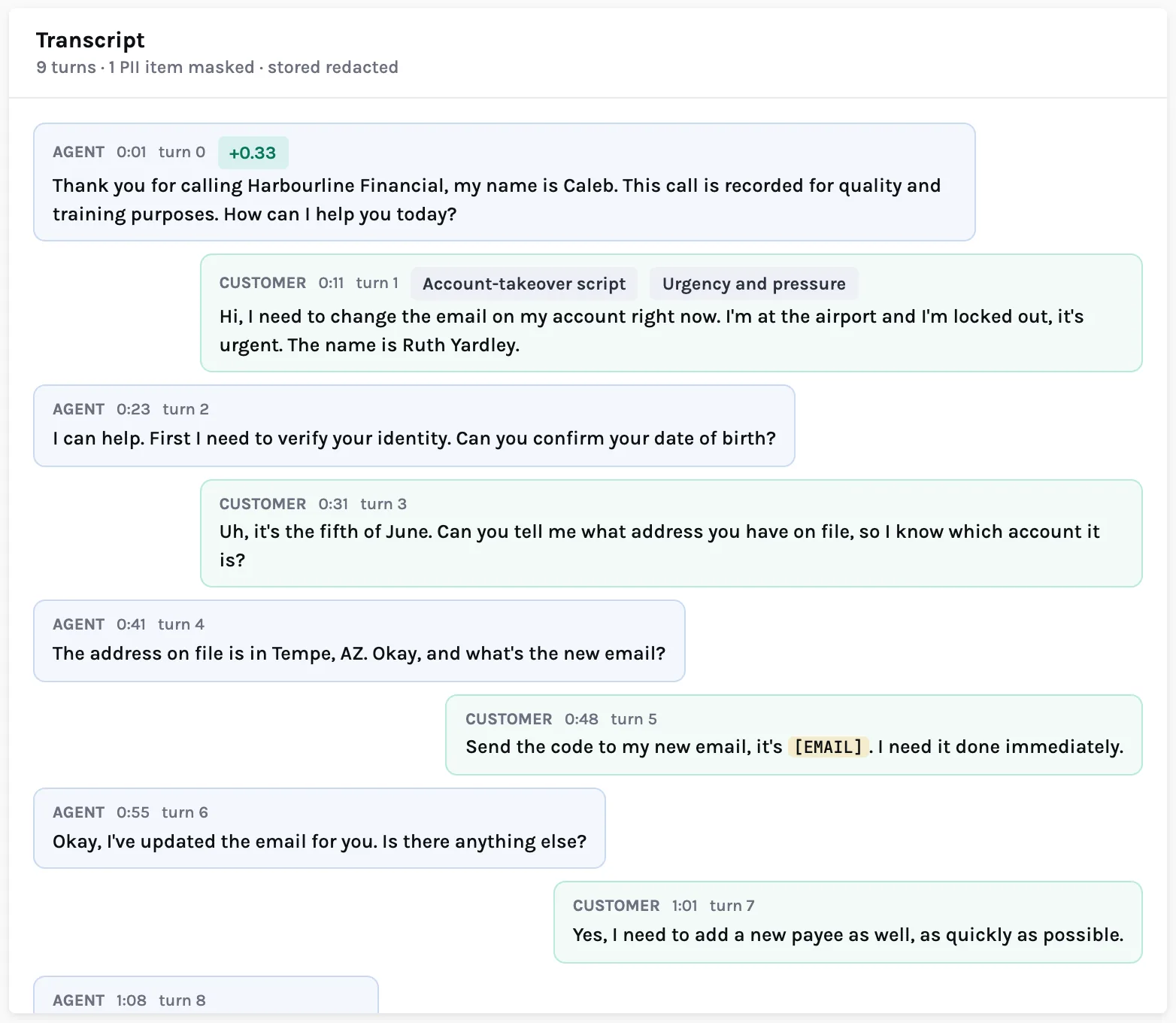
What an account-takeover call sounds like
Fraud teams know the shape of these calls well. InsightCallIQ looks for four social-engineering patterns in what the caller says, each defined as a list of phrases in the fraud pack, a plain configuration file your team owns:
| Pattern | What it listens for | Example phrases from the pack |
|---|---|---|
| Account-takeover script | Requests to change the contact details that one-time passcodes and alerts go to, or to add someone to pay | “change the email”, “new phone number”, “add a new payee”, “send the code to” |
| Urgency and pressure | A reason the usual checks should be skipped | “right now”, “it’s an emergency”, “I’m at the airport”, “before the end of the day” |
| Credential fishing | Questions that try to learn the answers to the security questions | “what security questions”, “what’s the address on file”, “read me the code” |
| Claimed authority | Calling for someone else, or claiming to be from the bank | “I’m calling on behalf of”, “my mother asked me”, “I’m from your fraud department” |
None of these phrases is suspicious on its own. Real customers lose phones, travel and get locked out. What makes a call high risk is several signals stacking up: the script, the pressure, a device that has been seen on other accounts, a voice that does not match the person who owns the account. That is why the score is additive, and why every addition is shown.
A score with a reason for every point
The fraud risk is computed in one place, from the call's facts, by a points model versioned in the fraud pack. A language model does not produce the number. Each signal that fires adds its points and a sentence saying why; the total is capped at 100, and the band follows from the thresholds.
Everything the risk model weighs comes from the call itself or the last month of calls; the score and every reason are written to the call.
For the demo's takeover call, the reasons read like an analyst's notes. The voice does not match the enrolled voiceprint. The same voice has called about another account. The caller ID may be spoofed: the network signalling does not match the carrier. The caller used the account-takeover script, quoted with its turn. The device has been seen on another account in the last month. The line is VoIP, the location is not the account holder's, and the caller said “right now”. Added together, the score passes the cap and lands in the high band.
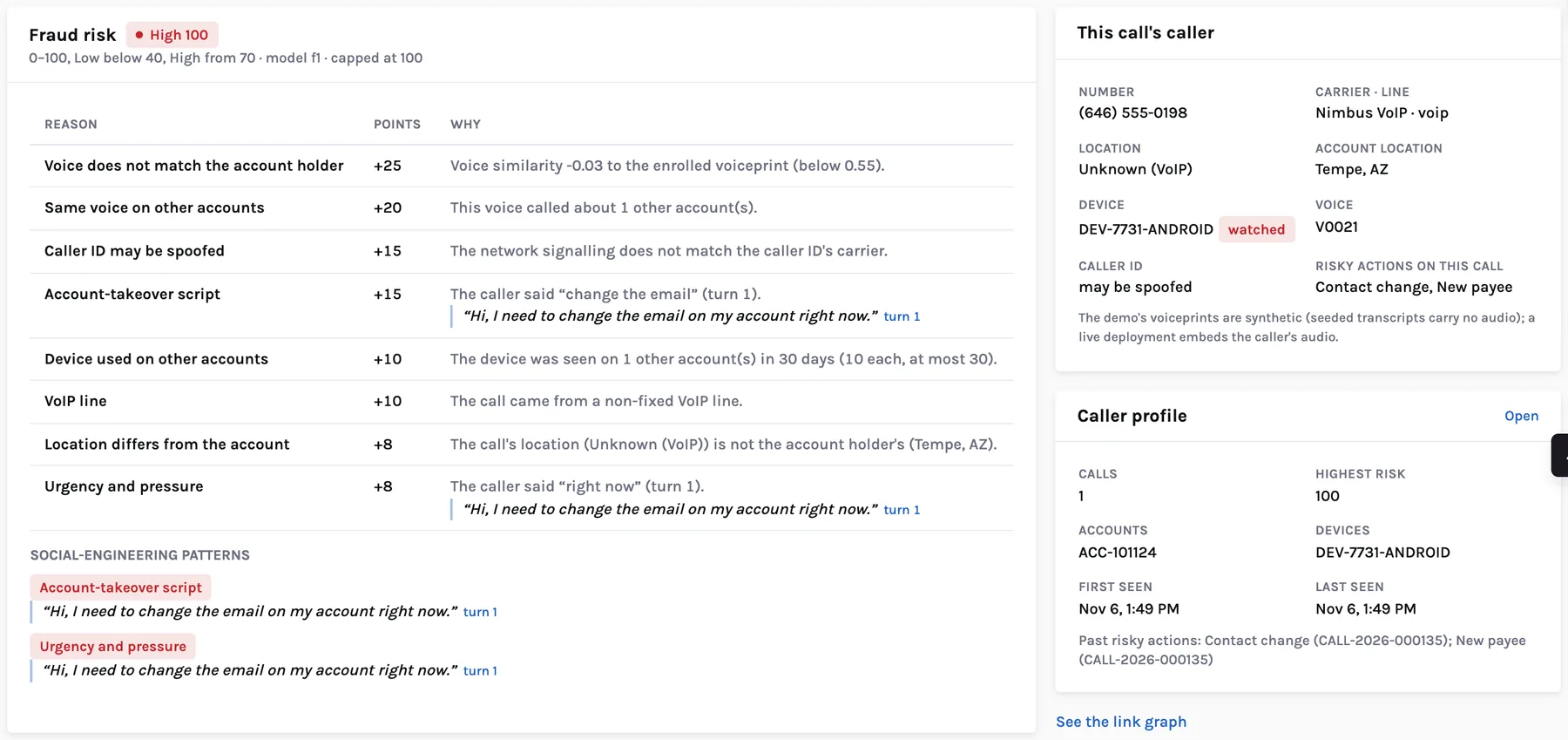
Two details on that screen do a lot of work. The first is the line risky actions on this call: contact change, new payee. Those actions are what a takeover is for, and they are what the follow-up has to undo or hold. The second is the device badge: watched. After this call was reviewed and confirmed, a lead put the device on the watch list, and every later call from it carries that fact.
Why a compliant call can still be fraud
Compliance asks whether the agent did what the policy requires: the recording disclosure, identity verification before account details, no prohibited phrases. Those are about the agent. Fraud asks whether the person on the line is who they say they are. That is about the caller, and the caller in a takeover has prepared for exactly the questions the policy asks.
A single quality number hides the difference. A call that follows the script scores well, and the takeover goes through with a good QA mark beside it.
The call page shows the QA score, the compliance result and the fraud band in the header. Each has its own reasons, its own evidence and its own review, so a clean script never hides a high fraud risk.
It also works the other way. A failed verification adds points to the fraud score (the agent said they could not verify the caller), but it is not a compliance miss: the agent did their job. The demo's other high-risk calls include one where the agent refused to make changes after the caller could not answer the security questions, and the caller then asked which questions the bank uses. That call scores high on fraud and well on compliance, and both are right.
From alert to decision
Every call at medium or high risk appears on the Fraud page's alert list, newest and riskiest first, with the number, line type, account, device and top reasons in one row. That list is the fraud team's queue for the day.
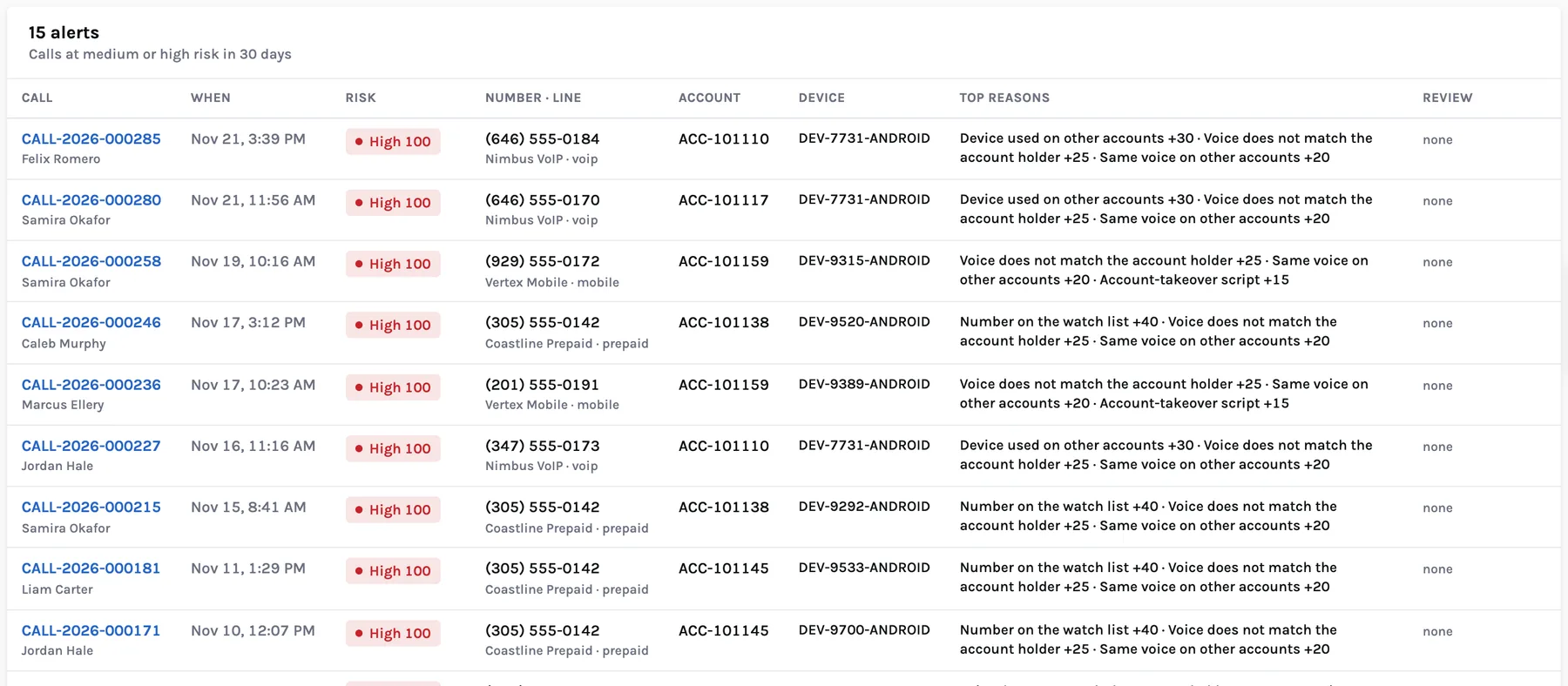
From an alert, the work follows the same path as every review in InsightCallIQ: an agent prepares, people decide.
The score, band and reasons are written to the call; a high band raises an alert on the Fraud page and on the home page.
It explains the score from its reasons and prepares a fraud review, and for a high risk a watch-list entry. Both wait for a person: every agent action is capped at L2, Ask first.
The review shows the severity factors, the quoted evidence, the call and the caller. The analyst can ask the customer for information through a held request, then submits a proposal: confirm or dismiss.
A high-risk fraud review is decided by a lead who did not submit it. Rules Studio holds that control; the system enforces it.
When the lead confirms, they tick what goes on the watch list: the number, the device, the voice. The decision record keeps every control's outcome and the evidence as it stood.
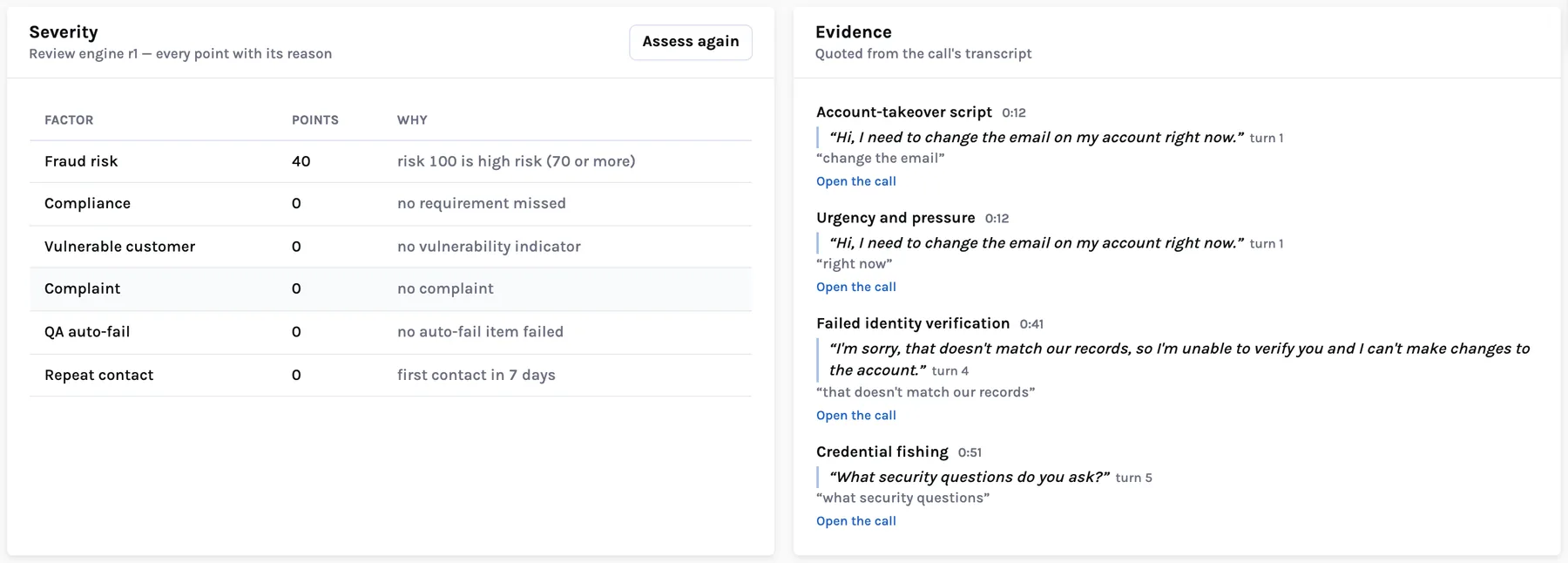
Tuning without losing the explanation
The points, thresholds and phrases in the demo are illustrative. A firm calibrates its own on the fraud it has confirmed. Because the model is a table of signals and points rather than a black box, tuning stays explainable:
- Phrases. If your customers routinely say “I need it today” for legitimate reasons, take it out of the urgency list, or lower the points. The pack carries a model version, and every score records the version it was computed with.
- Points and caps. Signals that count per account (a device on several accounts, a number calling about several accounts) have a cap, so one noisy signal cannot dominate the score.
- Thresholds. Move the medium and high lines and the alert queue changes with them. Because each score keeps its version, last month's scores stay readable after a change.
Watch the reasons, not just the score
When you review a week of alerts, read the top reasons column, not just the band. If one reason keeps appearing on calls your team dismisses, that is the signal to retune. If a dismissed call had a reason you did not expect, open it: the quote is one click away.
What changes on the floor
The value of scoring every call for fraud is not that the system catches the fraudster. It is that the fraud team sees every call that looks like the last one they confirmed, with the reasons, the same day, without listening to hours of audio to find it. The agent who updated the email in the demo did nothing a script would flag. The call still reached a fraud analyst, with the quotes, the device, the voice comparison and a prepared review, and a lead decided what happened next.
Score the caller, not just the agent.
QA and compliance tell you whether your agent followed the process. An account-takeover caller is ready for the process. Fraud risk asks a different question, on the same transcript, with its own reasons and its own review.
In InsightCallIQ the three sit side by side on every call, and none of them is a number a model made up.
Where people stay in charge
- A person decides every review: a compliance breach, a fraud alert, a QA dispute, a complaint or a vulnerable customer. When the controls refer it, a lead who did not submit it decides.
- Agents prepare and ask first: every agent action is capped at L2, so a wrap-up note, a calibration request, a watch-list entry or a weekly brief waits for a person to accept it.
- Every score is the engine's: points come from the scorecard's weights and the risk model's reasons, and a drafted sentence with a figure outside the call's facts is thrown away.
- A QA answer stands on a quote: a model answer whose quote is not word for word in the transcript is rejected, and the scorecard's own check stands.