In short
- Collections and servicing calls carry obligations that are easy to state and hard to evidence: say the recording notice, confirm the right person, give the debt-collection disclosure in time, never pressure the customer.
- InsightCallIQ checks each requirement on every call it applies to, with the transcript’s own words as evidence, and marks it met, missed, breached or not applicable.
- Requirements are policy you can read and edit: the phrases, the time window, which calls they apply to and their severity. A change is versioned and audited.
- A miss or breach becomes a compliance review that the compliance checker agent prepares and a person decides.
Ask a collections manager whether their agents give the debt-collection disclosure and the answer is always yes. Ask them to prove it for last Tuesday’s outbound calls and the answer becomes a project: pull recordings, listen, fill in a spreadsheet. By the time it is done, the agent who skipped it has made another few hundred calls.
This post works through how InsightCallIQ checks script and disclosure requirements on every collections and servicing call, using one outbound collections call from the Harbourline Financial demo. Harbourline is fictional, and so is the wording of its requirements: they are illustrative, and a firm sets its own. Nothing here is legal advice; it is a description of what the product checks and how it shows its evidence.
The requirements, written as checks
Every requirement in InsightCallIQ has a kind, the phrases that satisfy it, the speaker who must say them, the calls it applies to, a severity and the policy it comes from. The kinds cover the shapes compliance obligations actually take:
| Kind | Met when | Harbourline example |
|---|---|---|
| Required | the agent says one of the phrases, inside the time window if it has one | Recording disclosure; the debt-collection disclosure on outbound payment-plan calls |
| Required before | the phrase comes before the first account detail is given | Identity verified before account details, on inbound calls |
| Required if | a condition arose, and the agent said it after that point | Complaint acknowledged and logged; support offered to a vulnerable customer |
| Prohibited | none of the phrases is said; saying one is a breach | No threats or pressure; never asks for a PIN, password or passcode to be read out |
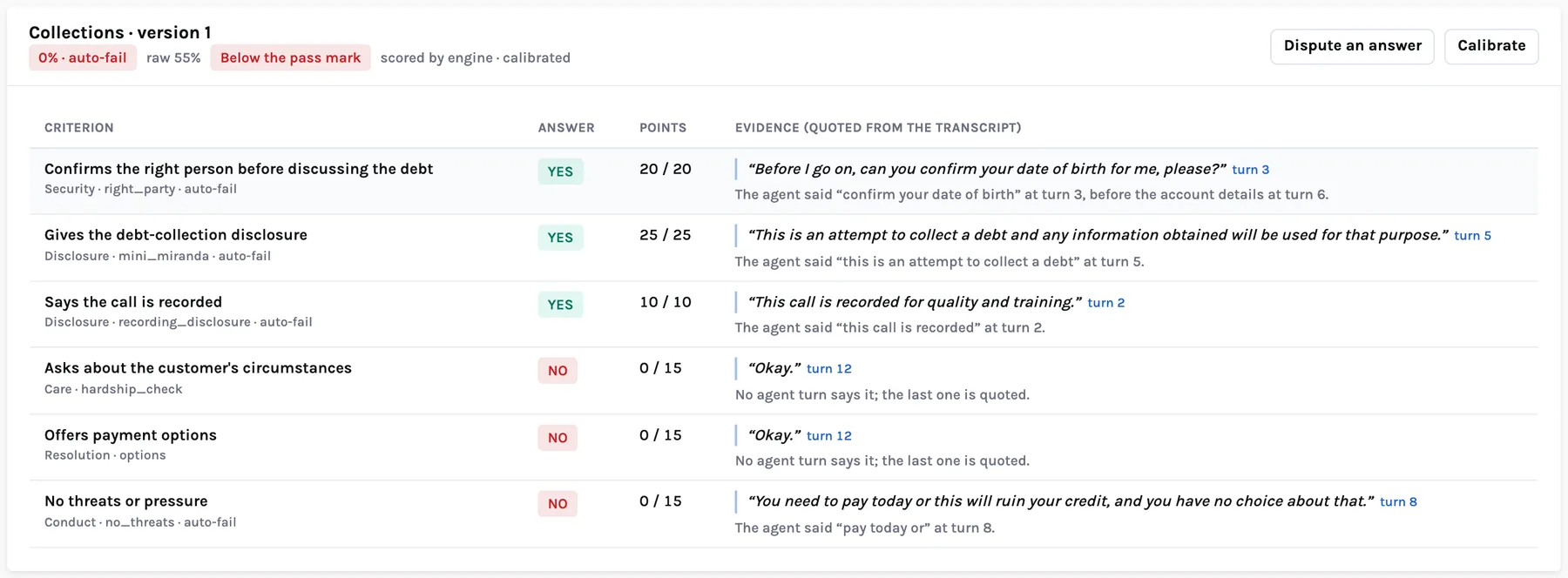
The result of each check is one of four statuses: met, missed, breach (a prohibited phrase was said) or not applicable. A required statement said after its window is a miss, and the evidence says so: “Said late”, with the time and the turn. A requirement that only applies to collections calls is not applicable on a card dispute, and is shown that way instead of counting as a pass.
One collections call, checked
An outbound call from Harbourline’s Collections and Hardship team, to a customer whose card account is past due. The call reason is a payment plan, so the debt-collection disclosure applies, and so does the Collections compliance scorecard.
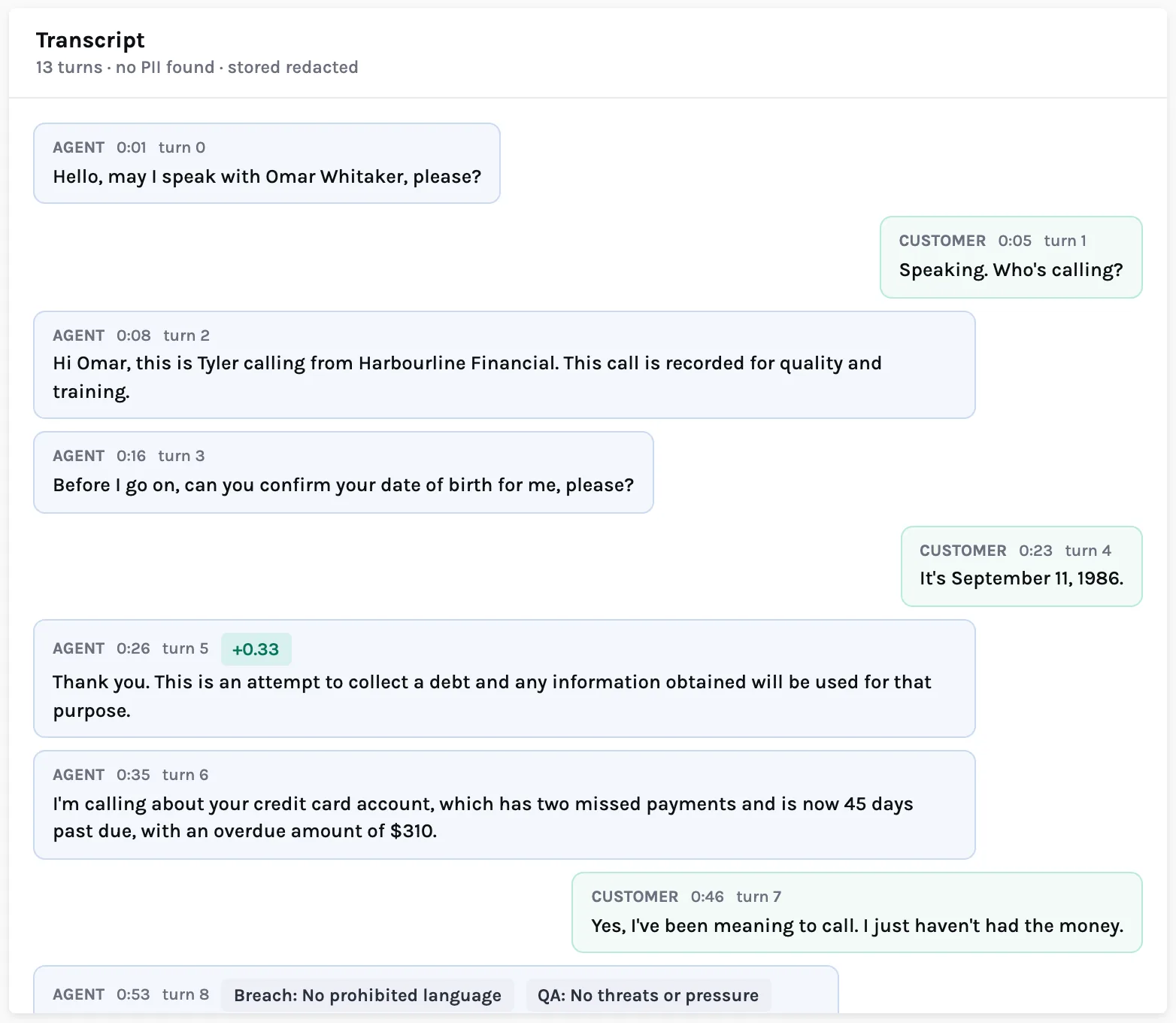
Reading the transcript the way InsightCallIQ does:
- Turn 2, the recording notice: “This call is recorded for quality and training.” Inside the window, so met.
- Turn 3, the right-party check: the agent asks for the date of birth before going on.
- Turn 5, the debt-collection disclosure: “This is an attempt to collect a debt and any information obtained will be used for that purpose.” Inside its window, so met.
- Turn 6, the first account detail: the balance and the missed payments, after the checks above.
- Turn 8, the breach: “You need to pay today or this will ruin your credit, and you have no choice about that.”
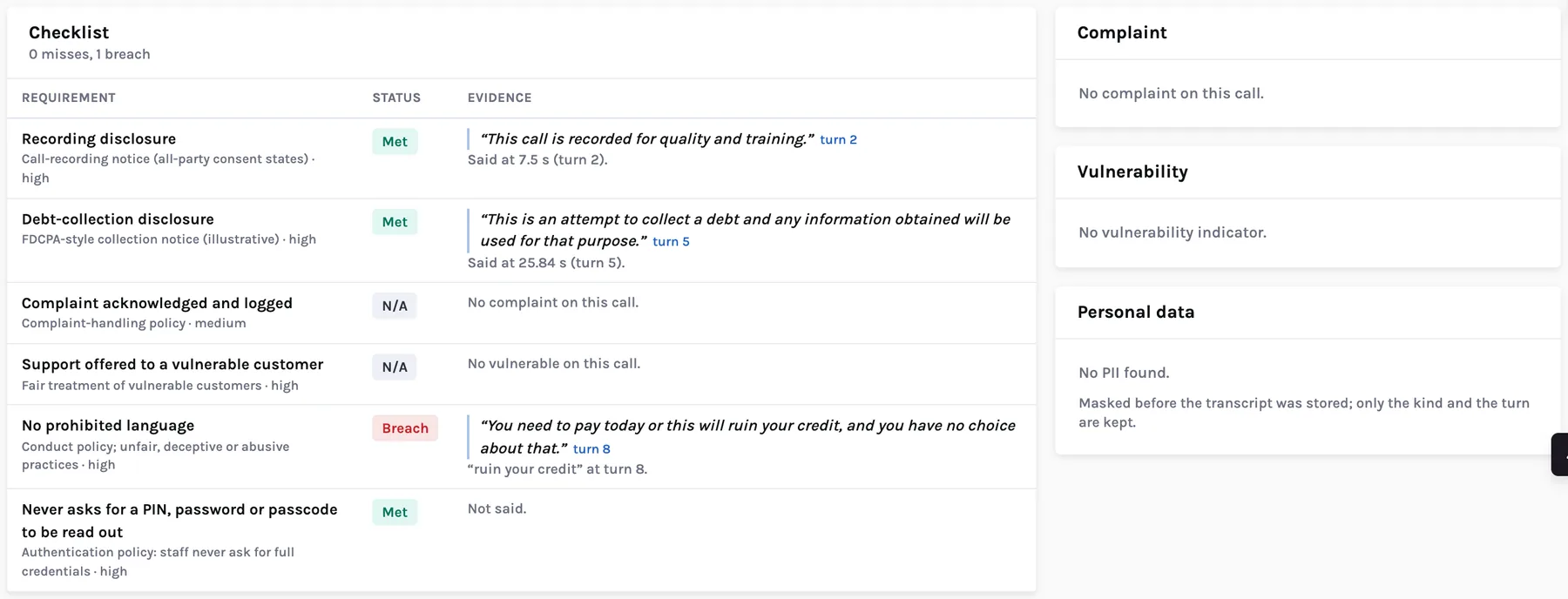
The same call on the Collections compliance scorecard tells the QA side of the story. Confirming the right person, the disclosure and the recording notice all earn their points; “no threats or pressure” is answered no, quoting turn 8. That criterion is an auto-fail, so the call scores zero, with the raw percentage kept beside it so a reviewer can see the rest of the call was largely in order.
Servicing calls: identity before account details
Collections is not the only place disclosures matter. On inbound servicing calls the requirement that matters most is identity verification before any account detail is given: it is the control that stops an account-takeover caller learning the balance, the last transaction or the address on file.
InsightCallIQ checks it as an ordering rule. It finds the first turn where the agent gives an account detail (phrases such as “your balance is” or “I can see a charge”) and asks whether a verification phrase came before it. On one Harbourline card-dispute call, the agent confirmed a merchant charge at turn 2 and only asked for the date of birth at turn 3. The verification happened; it happened too late, and the miss is tagged on turn 2, where the detail was given.
From one call to the whole floor
Every check on every call rolls up to the Compliance page: adherence by requirement, misses by agent, and the latest misses and breaches with the quote that proves each one. A compliance lead sees where the risk is concentrated before deciding where to look.
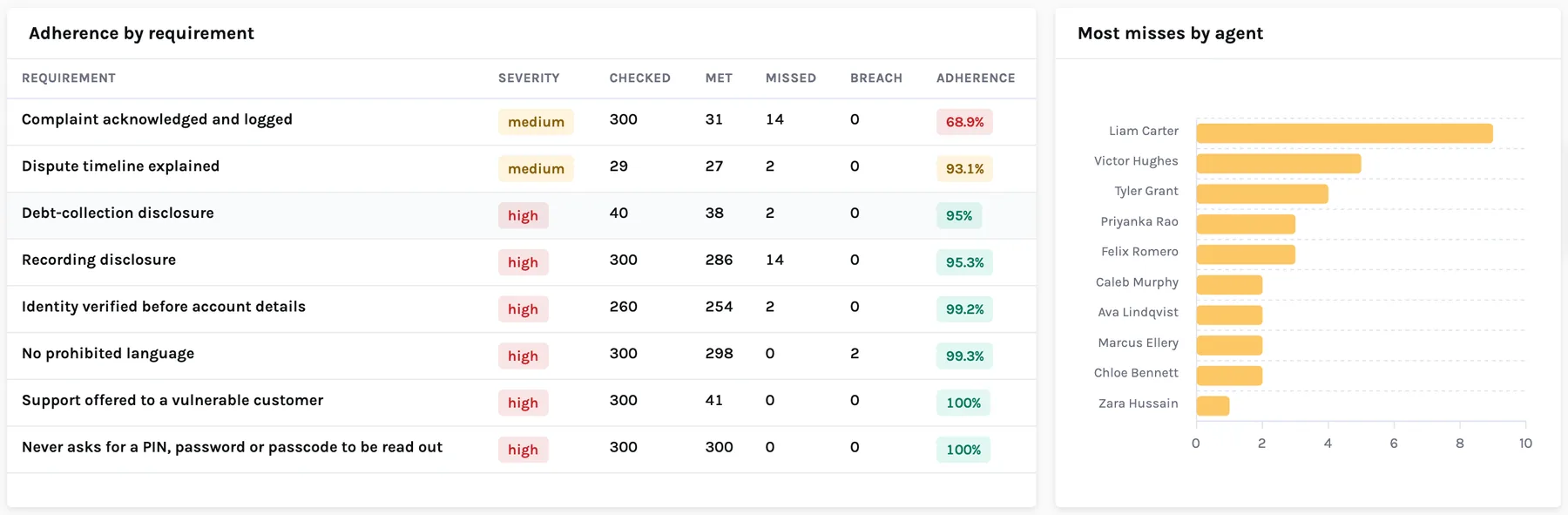
In the demo, the collections picture is specific: the debt-collection disclosure is checked on 40 calls, met on 38 and missed on 2, and both breaches of prohibited language come from the same collections agent, on calls a few days apart. That is a conversation for this week, not a finding for next quarter’s audit.
A miss leads two ways: a review for compliance, and a coaching moment for the agent’s lead.
Complaints and vulnerable customers
Two requirements only apply when something happened on the call. When a customer complains, the agent must acknowledge and log it. When a customer shows signs of vulnerability, such as financial difficulty or bereavement, the agent must offer support. InsightCallIQ detects both turn by turn with InsightService’s classifier, so the check knows the turn where the condition arose and looks for the required words after it. A collections call where the customer says they lost their job and the agent carries on with the payment demand is a missed vulnerability requirement, quoted from the turn where the customer said it.
What the compliance checker agent does, and what it does not
The compliance checker explains the misses and breaches from their quotes and prepares a compliance review, or a vulnerable-customer review. It asks first: the review is opened when a person accepts what it prepared. Deciding the review is a person’s, and when the controls refer it, a lead who did not submit it decides.
Changing a requirement without losing the history
Rules change: a regulator updates guidance, legal rewords a disclosure, a new product needs its own notice. On the Compliance page a lead edits a requirement’s phrases, window, scope or severity; each change is versioned and audited, so a result can always be read against the requirement as it stood when the call was checked. Collections teams should plan three habits around this:
Agents paraphrase. Add the approved variations as phrases, so a correct disclosure in different words is met, and a wrong one is not.
If the disclosure must come at the start of the call, give it a window. A late disclosure is then a miss with its time, not a pass.
Misses by agent show whether a problem is one person or a script. One person is coaching; many people is the script or the phrase list.
Every collections call, checked against the words your policy requires.
The proof a compliance lead needs is not a sample and an assurance. It is the requirement, the call, the turn and the quote, for every call the requirement applies to, and a person’s decision on each review.
Where people stay in charge
- A person decides every review: a compliance breach, a fraud alert, a QA dispute, a complaint or a vulnerable customer. When the controls refer it, a lead who did not submit it decides.
- Agents prepare and ask first: every agent action is capped at L2, so a wrap-up note, a calibration request, a watch-list entry or a weekly brief waits for a person to accept it.
- Every score is the engine's: points come from the scorecard's weights and the risk model's reasons, and a drafted sentence with a figure outside the call's facts is thrown away.
- A QA answer stands on a quote: a model answer whose quote is not word for word in the transcript is rejected, and the scorecard's own check stands.