In short
- Before anyone reads a word of a transcript, the shape of a call already says a lot: who talked, where it went quiet, where people spoke over each other, where voices rose.
- InsightCallIQ measures that shape on every call, deterministically, and ties every figure to the turns it comes from.
- The measurements are most useful read together, on the call’s timeline, next to sentiment by turn and the moments the checks found.
- Any measurement can become a scorecard criterion with a limit, such as no dead air longer than 15 seconds, and the score quotes the turn where it happened.
Every contact-centre leader has a sense of what a bad call sounds like: long silences while the agent searches for something, the customer and agent talking over each other, a voice getting louder. Those impressions are right more often than not. The problem is that they live in the heads of the people who happened to listen.
InsightCallIQ turns them into measurements that exist for every call. This post explains what is measured, exactly how each figure is defined, and how to read them together, using one escalated call from the Harbourline Financial demo (fictional, like every name in it).
What is measured on every call
Conversation analytics runs on every call after it is transcribed and redacted. It is deterministic: the same transcript always gives the same figures, and each figure records the turns it came from.
| Measurement | How it is defined | Why it matters |
|---|---|---|
| Talk and listen | each speaker’s talk time and share of the call | An agent talking most of the call is rarely listening; a customer talking most of it may be repeating themselves |
| Silence | the gap between the end of the talk so far and the next turn; the total and the longest gap | Long gaps are usually the agent searching systems or waiting on a colleague |
| Dead air | any gap of five seconds or more, with the turn it came before | The moments a customer notices and remembers |
| Overtalk and interruptions | a turn that starts while the other speaker’s turn is still running, beyond a short overlap; who interrupted whom | Agent interruptions are a coaching point; customer interruptions are often frustration |
| Raised voices | a turn at or above the loudness threshold | An escalation signal, often before the words say so |
| Sentiment by turn | each turn scored from a lexicon, from −1 to +1, with the customer’s start, end and average | Where the call turned, and whether it recovered |
| Reason and outcome | why the customer called, from a weighted phrase lexicon; resolved, saved, escalated, cancelled or unresolved | Puts every other figure in context |
| Conversation profile | questions asked and answered, offers made and accepted, problems solved, the agent’s average response time | How the conversation flowed, not only how long it was |
Overtalk is defined carefully so that ordinary back-and-forth is not counted: a turn only counts as an interruption if it starts more than a fraction of a second before the other speaker finishes. Silence is measured from the end of the talk so far, so a short reply that overlaps a long turn does not create a false gap.
One escalated call, read on its timeline
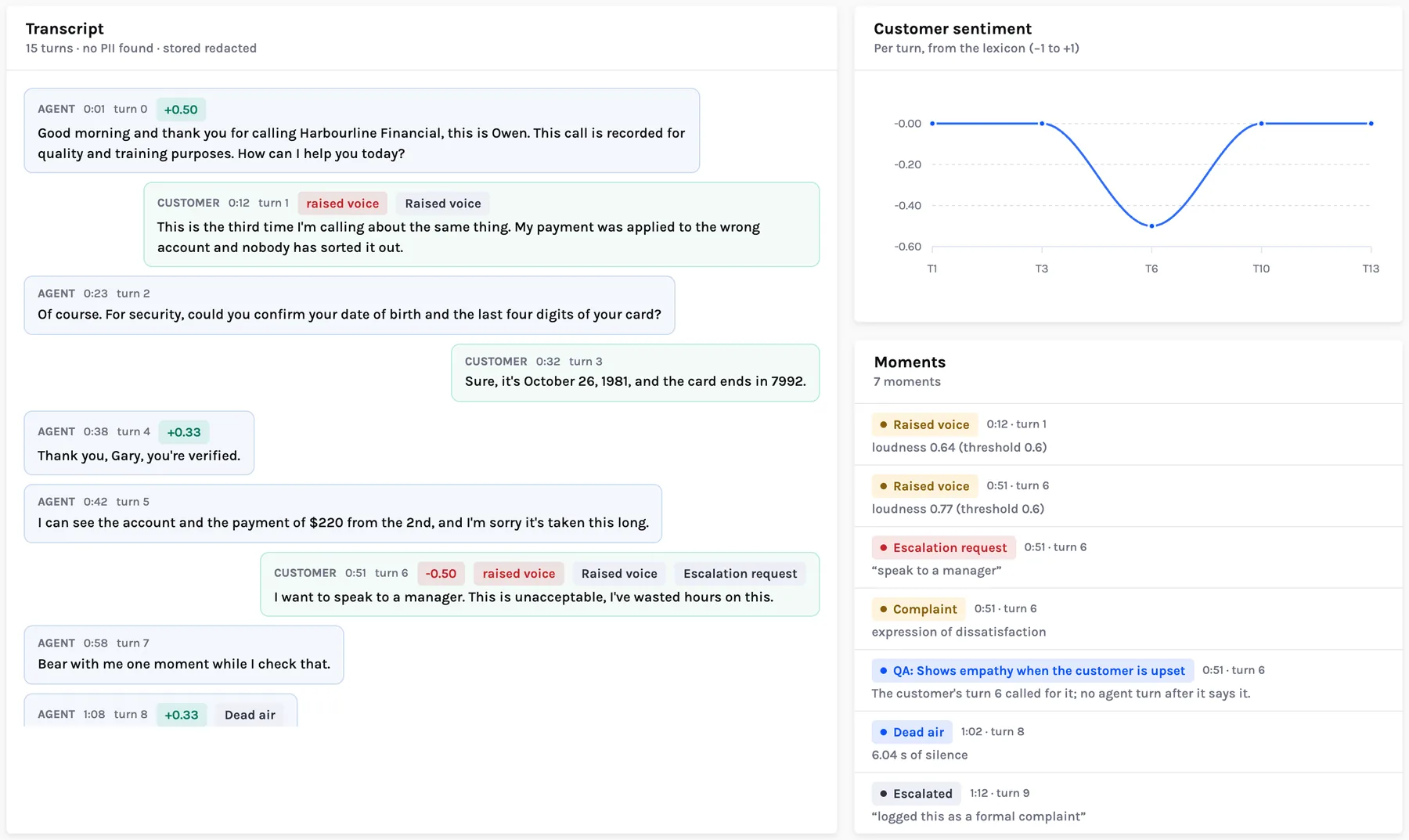
A Harbourline card-services call. The customer is calling for the third time about a payment applied to the wrong account. The timeline shows the call as InsightCallIQ measured it: the agent’s and the customer’s turns, the gaps, and markers for the moments the checks found.

Read left to right, the timeline already tells the story before the transcript is open:
The customer opens loud: “This is the third time I’m calling about the same thing.”
The agent verifies identity at turn 2 before giving account details at turn 5. That is a pass on the identity check.
“I want to speak to a manager.” The customer’s sentiment hits its lowest point here, and the turn is classified as a complaint.
A gap of a little over six seconds while the agent checks something. Not long enough to fail the scorecard limit, but it sits right after the customer’s hardest moment.
The agent moves the payment and logs a formal complaint. The outcome is escalated.
Reading the measurements together
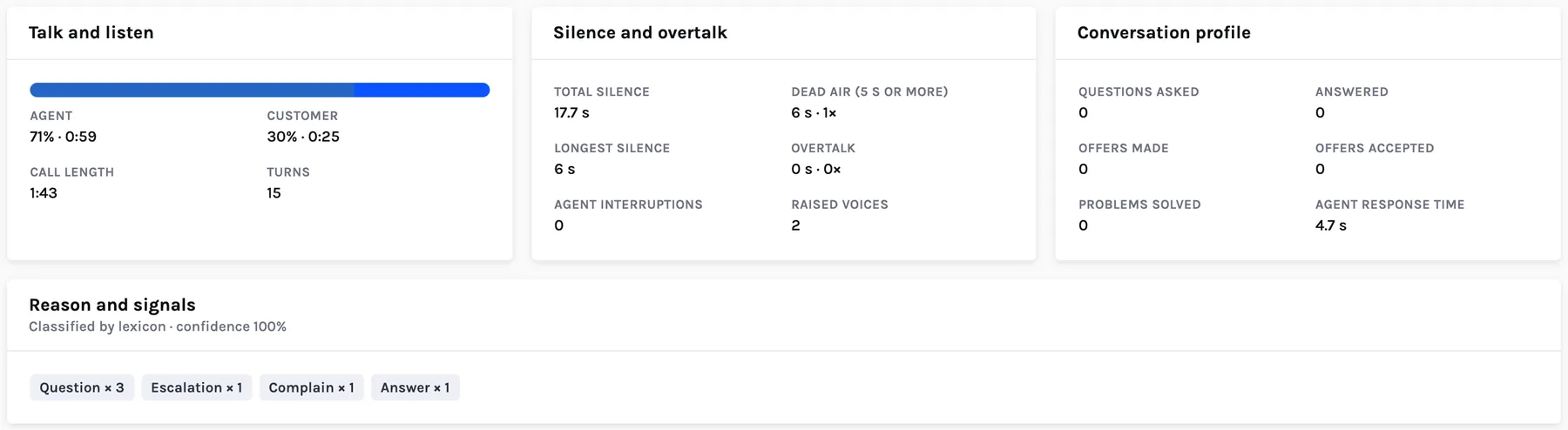
No single figure on that call is alarming. The silence is under the scorecard’s limit, the agent never talked over the customer, and the agent’s share of the talk is unremarkable for a call where the agent is explaining a fix. What makes the call worth a team lead’s attention is the order: the customer’s worst moment, then silence, and no turn that acknowledges the frustration. That is exactly where the Service quality scorecard’s empathy criterion answered no, quoting turn 6.
Some combinations worth learning to spot:
- Dead air straight after a negative customer turn. The customer has just said something hard and hears nothing back. Coaching point: acknowledge first, then go and look.
- Agent interruptions on a complaint call. The customer wants to be heard; being talked over makes escalation more likely. Coaching point: let the customer finish.
- A raised voice early, sentiment recovering by the end. A call that was saved. These are the calls to use as positive examples.
- High agent talk share with few questions answered. The conversation profile shows the agent explaining rather than finding out what the customer needs.
- Repeated long silences on one call reason. Across the floor, that is usually a process or a system, not an agent: the same lookup taking too long on every dispute call.
The same measurement points to different owners depending on what surrounds it.
From measurements to scorecard criteria
Any of the measurements can be turned into a scorecard criterion with a limit. Harbourline’s Service quality scorecard carries two: No dead air longer than 15 seconds and Does not talk over the customer, at most 2 interruptions. The answer records the measured value against the limit and quotes the turn where the longest silence or the last interruption happened, so the agent can find the moment.
The measurements a criterion can use are the longest silence, total dead air, agent interruptions, overtalk time, the agent’s talk share, the number of raised voices, the customer’s sentiment at the end of the call and the call’s duration. A lead adds or changes such a criterion on the Scorecards tab; the change is a new scorecard version, and earlier scores keep the version they were made with.
Measure first, limit carefully
A limit on a measurement is a blunt instrument. A long silence while the agent processes a refund the customer asked for is not a failure. Harbourline’s limits are generous on purpose: they catch the calls that are clearly wrong, and leave the judgement about the rest to the timeline and the team lead.
Across the floor
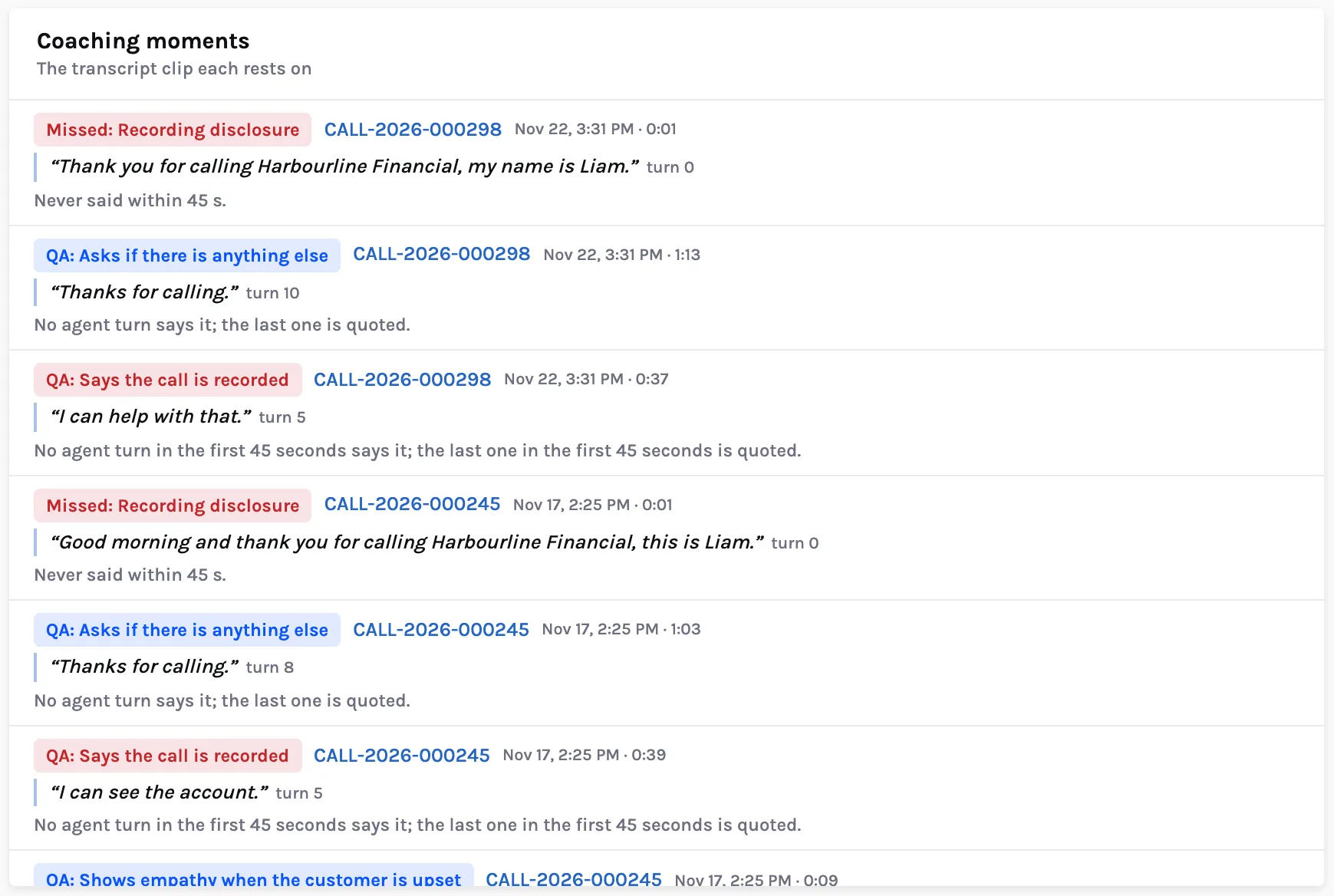
The same measurements roll up beyond the single call. The home page and the Insights page show sentiment at the end of calls by day, so a team lead can see a bad afternoon as it happens. The coaching page lists each agent’s figures, including average handle time and sentiment at the end of their calls, beside their QA results. And the coaching moments list shows each QA miss, including the call-control criteria for dead air and interruptions, with its transcript clip.
The shape of a call is evidence too.
Silence, overtalk, raised voices and sentiment are measured on every call and tied to their turns. Read on the timeline, they show where a call turned. Put on a scorecard with a sensible limit, they become criteria an agent can see, check and learn from.
Where people stay in charge
- A person decides every review: a compliance breach, a fraud alert, a QA dispute, a complaint or a vulnerable customer. When the controls refer it, a lead who did not submit it decides.
- Agents prepare and ask first: every agent action is capped at L2, so a wrap-up note, a calibration request, a watch-list entry or a weekly brief waits for a person to accept it.
- Every score is the engine's: points come from the scorecard's weights and the risk model's reasons, and a drafted sentence with a figure outside the call's facts is thrown away.
- A QA answer stands on a quote: a model answer whose quote is not word for word in the transcript is rejected, and the scorecard's own check stands.