In short
- Sampled QA tells you how a handful of calls went. It cannot tell you which calls went wrong, because it never heard them.
- InsightCallIQ scores every call on the scorecards that apply to it, and every answer carries the transcript turn it rests on.
- Scorecards are versioned: a lead edits the criteria, weights and auto-fail items, and every score records the version it used.
- The time QA analysts used to spend listening moves to calibration and disputes: the calls where a person’s judgement changes the result.
Most contact-centre quality programmes are built on a sample. An analyst picks a few calls per agent each month, listens end to end, fills in a form and writes a comment. The form is careful, the analyst is good, and the programme still misses almost everything, because almost every call is never heard.
This post walks through what changes when the sample becomes the whole population: how InsightCallIQ decides which scorecard a call is scored on, how each answer is reached and evidenced, what the score means, and where the QA team’s time goes once nobody has to listen to a call just to fill in a form. Every screen is from the demo: Harbourline Financial, a fictional card-servicing and collections contact centre.
What a sample can and cannot tell you
A sample is good at one thing: estimating an average. If the question is “roughly how well does this team greet customers?”, a few calls per agent will give a fair answer. The trouble is that the questions a QA and compliance lead actually gets asked are not about averages.
- “Which calls gave account details before verifying the caller?” A sample finds some of them by luck. The rest are still out there.
- “Did anyone pressure a customer on a collections call this week?” One such call is a problem. A sample that missed it says nothing about it.
- “Is this agent improving?” A handful of scored calls a month moves around with which calls were drawn, not with what the agent did.
The second problem is the form itself. A sampled score is an analyst’s reading of a call: “empathy: partial”. When an agent disagrees, the conversation is about the analyst’s impression, because the form does not say which words the score rests on. Scoring every call fixes the first problem; putting the evidence on the page fixes the second.
The score is an estimate of the agent’s average. The worst calls of the month are found only if they happen to be drawn. Each answer is the analyst’s impression.
Every call is scored the same way, so a miss is found wherever it happened. Each answer quotes the turn it rests on, and a person reviews the scores worth a second look.
Which scorecard a call is scored on
A collections call and a card-dispute call should not be judged against the same form. In InsightCallIQ each scorecard says which calls it applies to, by direction (inbound or outbound) and by call reason. A call is scored on every scorecard that applies to it, and the reason comes from the conversation analytics that run first on every call.
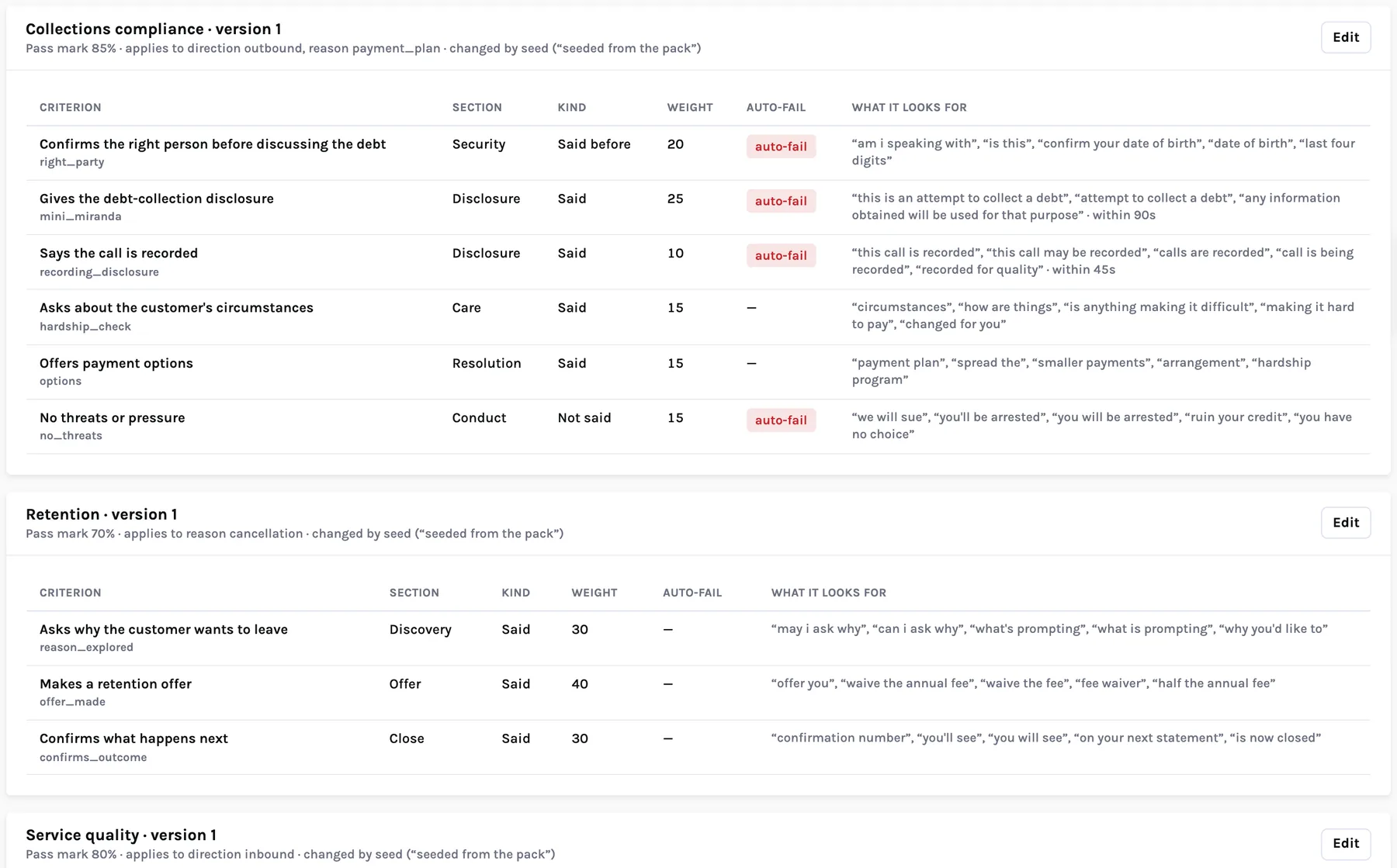
The Harbourline demo carries three scorecards, all illustrative and all editable:
| Scorecard | Applies to | What it checks |
|---|---|---|
| Service quality | inbound calls | greeting, the recording notice, identity verification before account details, empathy when the customer is upset, a resolution, next steps, call control (dead air and talking over the customer), the closing and prohibited language |
| Collections compliance | outbound calls whose reason is a payment plan | right-party confirmation before the debt is discussed, the debt-collection disclosure, the recording notice, asking about the customer’s circumstances, payment options, and no threats or pressure |
| Retention | calls whose reason is a cancellation | asking why the customer wants to leave, making a retention offer, and confirming what happens next |
Every call takes the same path: the scorecards that apply, a quoted answer per criterion, then the points.
How each answer is reached
A criterion is not a free-text question. It is one of five kinds, each a precise check against the transcript and the call’s measurements:
| Kind | Answers yes when | Example from the demo |
|---|---|---|
| said | the speaker says one of the phrases, inside a time window when the criterion has one | “Says the call is recorded”, within the opening of the call |
| said before | the phrase comes before the first account-detail marker | “Verifies identity before account details” |
| said if | the condition arose, and the agent said it after that point; otherwise it is not applicable | “Shows empathy when the customer is upset” |
| not said | none of the prohibited phrases is said | “No prohibited language” |
| metric at most | a measured figure is at or under its limit | “No dead air longer than 15 seconds” |
Phrases are matched as word sequences, not as loose keywords, and the answer records the sentence that carried the phrase and the turn number. When the answer is no, InsightCallIQ still quotes something: the last turn inside the window, so a reviewer can see what the agent said instead. When nothing could be quoted, as with a prohibited phrase that was never said, the evidence reads “Checked: not found in the call”.
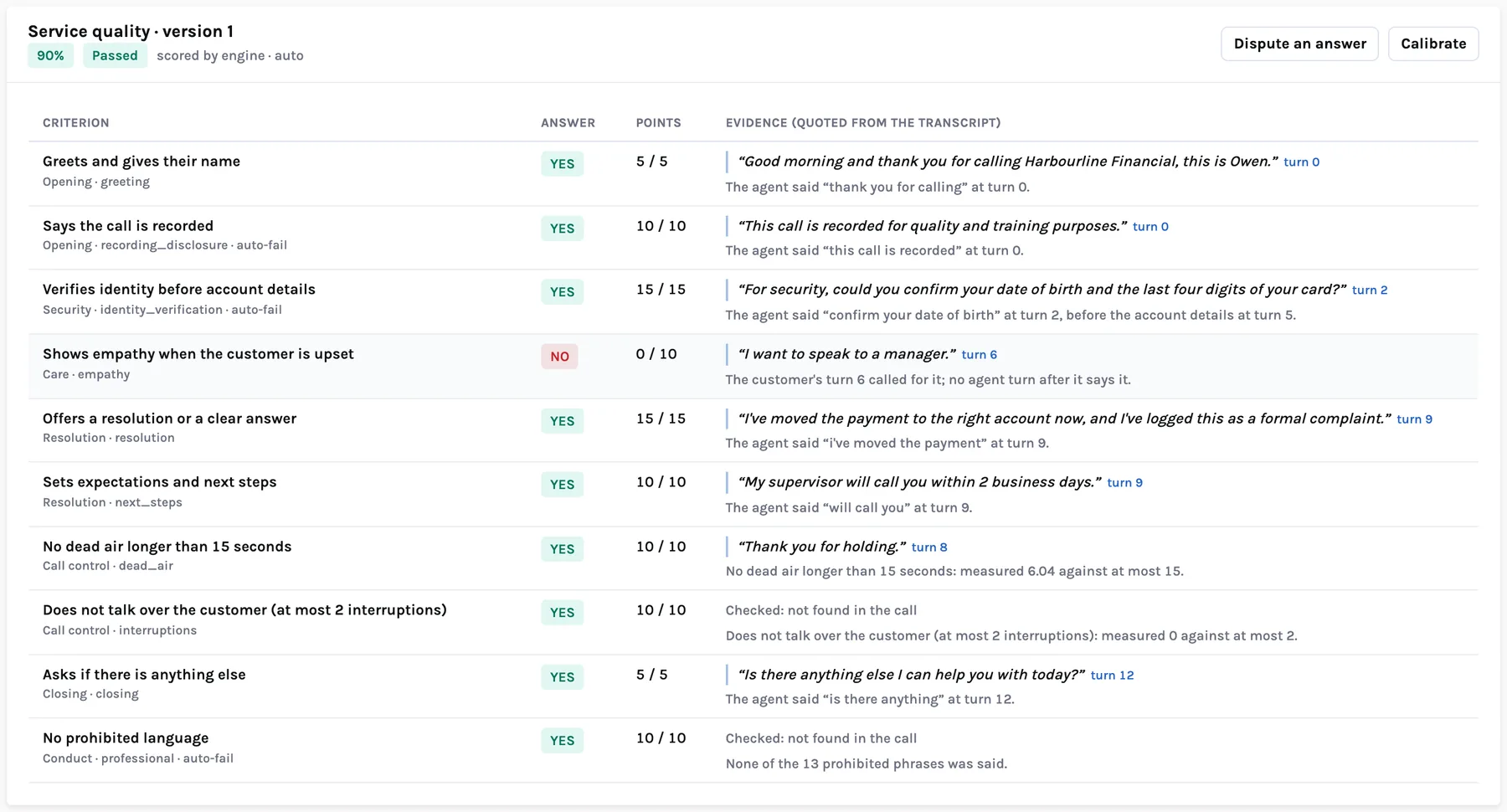
What the score means
The arithmetic is deliberately plain, so that anyone can redo it from the page:
- Points are the weights. A yes earns the criterion’s weight; a no earns nothing. There is no partial credit invented by a model.
- Not applicable is left out. If the customer was never upset, the empathy criterion is not applicable and its weight leaves the maximum, so the agent is neither rewarded nor punished for it.
- Auto-fail items zero the score. Skipping the recording notice, giving account details before verification or using prohibited language makes the score 0, and the raw percentage is kept beside it so a reviewer can see how the rest of the call went.
- Each scorecard has its own pass mark. The demo uses a higher bar for collections than for retention, because the risk is different.
On the call above, the customer turned negative at turn 6 (“I want to speak to a manager”) and no later agent turn acknowledged it. That single no costs the empathy weight. Everything else is yes, so the call scores 90% and passes. The point is not the number; it is that a team lead can read why it is 90% in ten lines.
Across the floor: the overview a lead opens on Monday
Once every call is scored, the QA page stops being a list of forms and becomes a picture of the floor. For each scorecard it shows how many calls were scored, the average, the pass rate, the number of auto-fails and how many scores a person has revised or calibrated, and then each criterion’s share of yes answers.
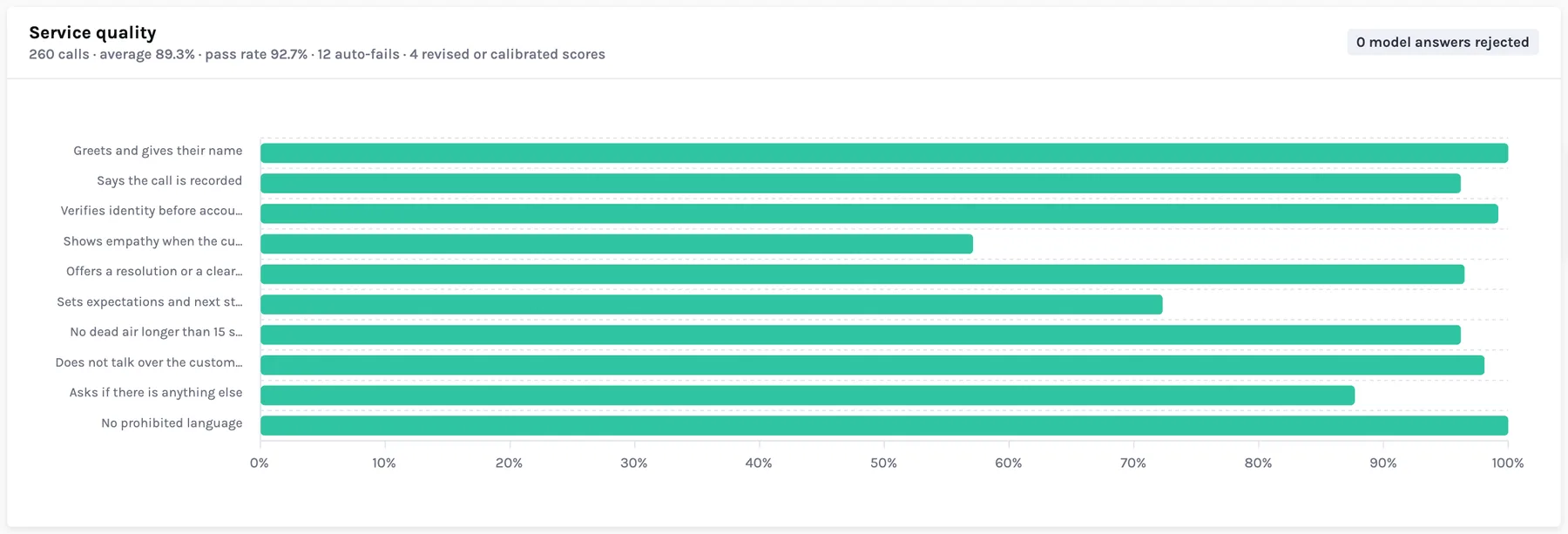
The bars are where coaching starts. In the demo, empathy and next steps are the two criteria most often answered no on Service quality. That is a training topic for the whole team, found without anyone listening to a single call. The individual cases are one click away, each with its quote.
Scorecards change. Scores remember which version they used.
A scorecard is a policy, and policies move: a new disclosure, a reworded greeting, a weight that turned out to matter more. On the Scorecards tab a lead edits the criteria, weights, phrases, auto-fail flags and pass mark. Saving creates a new version beside the old one, with who changed it and a note, and the change goes on the audit trail. Every score records the version it was made with, so last month’s results are never silently re-graded against this month’s rules.
Where the QA team’s time goes now
Scoring every call does not remove QA analysts. It changes what they do with their day: less listening to calls to fill in forms, more judging the scores where a person’s view matters.
The queue puts first the scores the QA scorer agent asked a person to check, then auto-fails, then a random sample. The analyst answers the criteria themselves; InsightCallIQ records how far they agreed with the automatic answers and rescores the call.
Which criteria are most often no, by scorecard. A falling bar is a training topic; a sudden drop on one criterion often means a phrase list needs a new wording.
An agent or analyst disputes one answer, says what it should be and why. A lead who did not raise it decides. An upheld dispute revises the answer and rescores the call.
When calibration keeps disagreeing on the same criterion, the lead changes its phrases or weight. The new version applies from then on; older scores keep theirs.
Calibration is where trust in automatic scoring is earned. Every calibration records the agreement between the person and the engine, criterion by criterion, and which criteria they disagreed on. If the disagreements cluster on one criterion, that criterion’s wording is the thing to fix, not the whole programme.
The QA scorer agent prepares; a person calibrates
InsightCallIQ’s QA scorer agent scores calls and, for a borderline or auto-failed score, prepares a request for a person to calibrate it. The request waits for someone to accept it. Calibration itself is always a person’s: the system refuses a calibration submitted by an agent.
What a lead can say that they could not before
With a sample, a QA lead reports an estimate. With every call scored and evidenced, the same lead can answer the questions that actually arrive from compliance, operations and the agents themselves:
- “How many calls skipped the recording notice last month, and which?” A filter, not a project.
- “Why did I fail that call?” The agent reads the quote behind each answer, and can dispute one answer instead of arguing about the whole call.
- “Did the new greeting land?” The criterion’s share of yes answers before and after the scorecard version changed.
- “Who needs coaching, and on what?” The coaching page reads the same answers per agent; in the demo one agent’s repeated recording-notice misses stand out at once, each with the call it happened on.
Score the whole population; spend people on the judgement.
Every call gets the same scorecard, the same arithmetic and a quote for every answer. People spend their time where it changes the outcome: calibrating the borderline scores, deciding disputes and improving the scorecard itself.
The next post in this series looks at the quote itself: why a QA answer without one is an opinion, and how InsightCallIQ refuses an answer whose quote is not really in the call.
Where people stay in charge
- A person decides every review: a compliance breach, a fraud alert, a QA dispute, a complaint or a vulnerable customer. When the controls refer it, a lead who did not submit it decides.
- Agents prepare and ask first: every agent action is capped at L2, so a wrap-up note, a calibration request, a watch-list entry or a weekly brief waits for a person to accept it.
- Every score is the engine's: points come from the scorecard's weights and the risk model's reasons, and a drafted sentence with a figure outside the call's facts is thrown away.
- A QA answer stands on a quote: a model answer whose quote is not word for word in the transcript is rejected, and the scorecard's own check stands.